Why Antistatic Protection Matters in Electronic Component Packaging
Electrostatic discharge remains one of the most underestimated failure modes in electronic component packaging. A static event of as little as 100 volts — imperceptible to human touch — can permanently damage gate oxides, degrade junction performance, or introduce latent defects that only manifest after the component reaches the end customer. Unlike physical damage, ESD-induced failures are difficult to detect through standard visual inspection and often pass functional testing before causing field returns.
In tape-and-reel packaging, the risk is particularly acute. As cover tape peels away from the carrier during automated pick-and-place, triboelectric charging occurs at the tape-component interface. Without proper antistatic protection built into the tape material itself, this charging event can discharge directly through the component being placed — at exactly the moment it is most exposed and most vulnerable.
Effective antistatic protection in packaging materials must therefore be intrinsic to the film or coating rather than applied as a secondary treatment that degrades over time or through repeated handling.
Understanding Surface Resistance Specifications for Tape Materials
Surface resistance is the primary metric used to classify the electrostatic behavior of packaging materials, including carrier tapes and cover tapes. It is measured in ohms per square (Ω/sq) and determines how quickly charge dissipates across a material's surface. Industry standards define three operational categories:
- Conductive: Surface resistance below 1 × 10⁴ Ω/sq — dissipates charge rapidly but may introduce unwanted current paths near sensitive circuitry.
- Dissipative: Surface resistance between 1 × 10⁴ and 1 × 10¹¹ Ω/sq — the preferred range for most ESD-sensitive component packaging, allowing controlled charge bleed-off without abrupt discharge.
- Insulative: Surface resistance above 1 × 10¹² Ω/sq — provides no static protection and is unsuitable for ESD-sensitive applications.
ANSI/ESD S541 and JESD22-A114 are the primary reference standards governing surface resistance requirements for component packaging materials in the semiconductor supply chain. Procurement teams should confirm that tape suppliers provide lot-level surface resistance data traceable to these or equivalent test methods, rather than relying solely on nominal datasheet values.
Ruital Electronics conducts surface resistance verification as part of its standard production quality protocol, ensuring that each batch of antistatic tape products meets the dissipative range required for ESD-sensitive environments.
Cover Tape Construction and Its Impact on ESD Performance
Not all antistatic cover tapes achieve their ESD performance through the same mechanism, and the construction method has practical implications for process stability. The three main approaches are:
- Coated antistatic layer: A conductive or dissipative coating applied to the film surface. Cost-effective but susceptible to wear, solvent exposure, and surface contamination reducing effectiveness over time.
- Compounded antistatic film: Antistatic agents incorporated into the base film during extrusion. More durable than surface coatings and maintains consistent surface resistance across the full reel length.
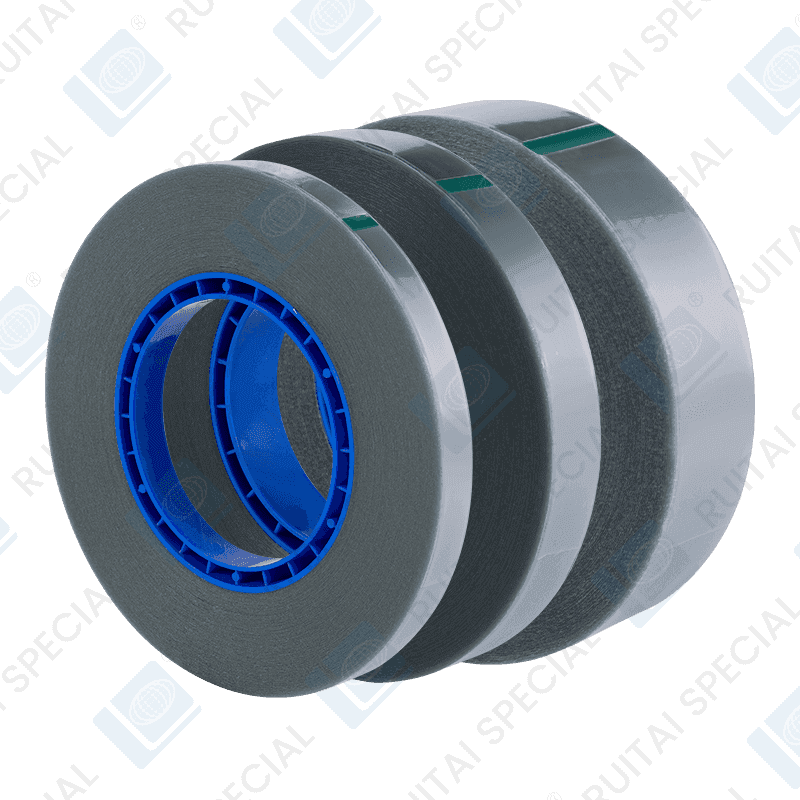
- Multilayer laminate construction: Combines a base film, functional antistatic layer, and heat-seal adhesive layer — each optimized independently — to balance ESD performance, peel force consistency, and optical clarity for vision system compatibility.
For high-speed automated assembly lines, multilayer laminate cover tape constructions offer the most predictable performance because the antistatic layer is isolated from the adhesive chemistry, preventing interactions that could shift either peel force or surface resistance under thermal or humidity stress.
Qualifying Antistatic Tape for New Component Packaging Lines
Introducing a new cover tape into an existing packaging line requires more than verifying that the material meets published ESD specifications. A structured qualification process typically involves four evaluation areas: surface resistance consistency across reel lengths and lots, peel force behavior at actual line speed and temperature, compatibility with the carrier tape pocket geometry and sealing equipment settings, and residue assessment after peel to confirm no adhesive transfer onto component contacts or carrier pockets.
A practical qualification protocol should include accelerated aging samples — tapes stored at elevated temperature and humidity — to confirm that surface resistance values remain within the dissipative range after simulated shelf-life exposure. Materials that perform within specification when fresh but drift into the insulative range after aging present a latent supply chain risk that standard incoming inspection will not catch.
With intelligent production lines and in-depth expertise across adhesive tape applications for the semiconductor sector, Ruital Electronics supports customers through the full qualification cycle — providing sample reels, test data, and application guidance to reduce time-to-approval for new packaging material deployments.


 USA
USA English
 日本語
日本語 中文简体
中文简体