
 USA
USA English
 日本語
日本語 中文简体
中文简体
Content
- 1 Integrated Circuit Package Types and Their Packaging Requirements
- 2 How Package Geometry Drives PSA Cover Tape Specification
- 3 QFN and No-Lead Packages: The Dominant Volume Driver for PSA Cover Tape
- 4 ESD-Sensitive IC Packages and Antistatic PSA Cover Tape Requirements
- 5 Selecting PSA Cover Tape Across Multiple IC Package Types on a Shared Line
Integrated Circuit Package Types and Their Packaging Requirements
Integrated circuit packages fall into several broad families defined by their lead configuration, body construction, and mounting method. Each family presents distinct requirements for carrier tape pocket geometry, component retention forces, and cover tape peel behavior — making package type the primary variable when specifying PSA cover tape for a tape-and-reel packaging operation.
The main IC package categories in active production volume today are through-hole packages, surface mount leaded packages, area array packages, and no-lead flat packages. Each has different dimensional profiles, weight ranges, and center-of-gravity characteristics that interact with cover tape adhesion and peel dynamics in different ways.
| Package Family | Common Types | Tape-and-Reel Suitability | Cover Tape Consideration |
|---|---|---|---|
| Small outline | SOP, SOIC, SSOP, TSOP | Standard | Lead clearance from pocket walls critical |
| Quad flat pack | QFP, LQFP, TQFP | Standard | Gull-wing leads require precise pocket depth |
| No-lead flat | QFN, DFN, LGA | Standard — high volume | Low profile; shallow pockets need secure cover seal |
| Area array | BGA, CSP, FBGA | Standard for CSP/FBGA; tray preferred for large BGA | Solder ball protection from cover contact essential |
| Small transistor / diode | SOT-23, SOT-363, SC-70 | High volume — narrow tape | Very light components; peel force upper limit critical |
How Package Geometry Drives PSA Cover Tape Specification
PSA cover tape peel force must be matched to the component it retains. IEC 60286-3 defines the peel force acceptance window as 0.1 N minimum to 0.7 N maximum at standard test conditions, but the practical operating range for a given package type is considerably narrower once handler specifications and component displacement risk are factored in.
For lightweight components such as SOT-23 transistors — typically weighing under 5 mg — the upper peel force limit is the binding constraint. Excessive peel force at high handler speeds can lift the component out of the pocket before the placement nozzle engages, or cause the component to rotate within the pocket as the tape peels asymmetrically. PSA tapes specified for these packages use lower-tack adhesive formulations and are validated at the actual handler peel speed, which commonly ranges from 800 to 2,000 mm/min rather than the 300 mm/min used in standard laboratory peel tests.
For heavier packages such as large QFP or LQFP devices with body sizes above 14 mm, the lower peel force limit becomes the binding constraint. The component weight and the lateral forces generated by transport vibration and reel acceleration require sufficient adhesion to prevent pocket opening during handling. PSA systems are inherently more sensitive to temperature-driven peel force reduction than HAA alternatives, making ambient temperature monitoring a necessary process control for heavy-component PSA cover tape applications.
BGA and CSP packages introduce an additional constraint specific to area array devices: the cover tape must not contact solder balls during transport. Any tape sag into the pocket — caused by insufficient film stiffness or carrier pocket depth tolerance variation — risks deforming balls or transferring adhesive to ball surfaces, compromising solderability. Cover tape film modulus and pocket clearance verification are therefore package-specific qualification requirements for these device types.
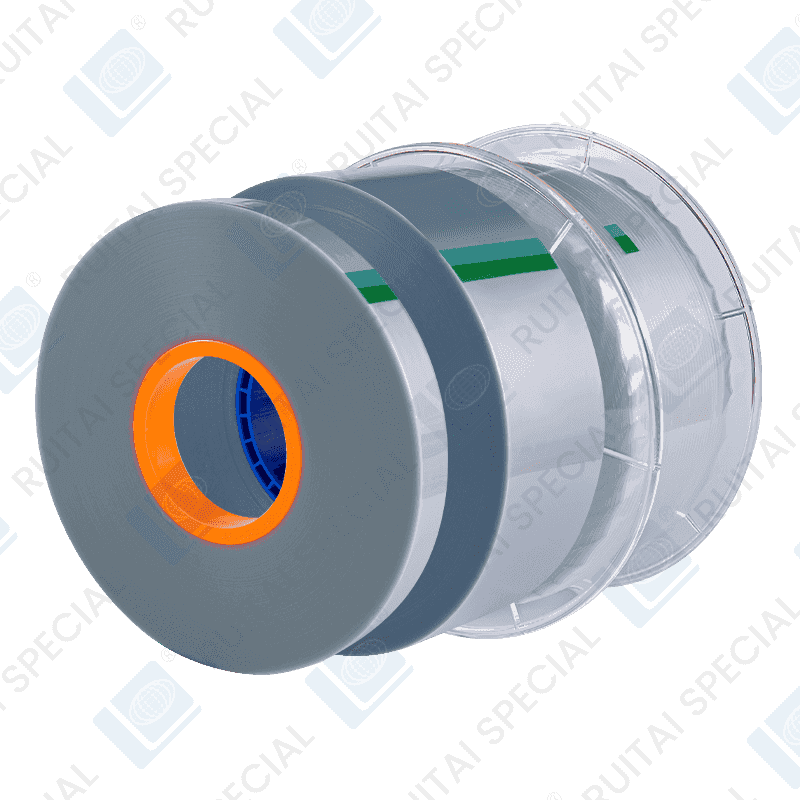
QFN and No-Lead Packages: The Dominant Volume Driver for PSA Cover Tape
QFN (Quad Flat No-Lead) and DFN (Dual Flat No-Lead) packages have become the highest-volume IC package types in active production, driven by their compact footprint, low thermal resistance, and compatibility with fine-pitch PCB designs. The global QFN market volume exceeded 50 billion units annually as of recent industry estimates, making PSA cover tape specified for no-lead packages the single largest application segment within the semiconductor packaging tape market.
No-lead packages present a specific cover tape challenge: their low profile and flat bottom surface mean that carrier tape pocket depth is shallow — typically 0.6 to 1.2 mm for standard QFN body thicknesses — leaving minimal clearance between the component top surface and the cover tape underside. This geometry requires tight control over three PSA tape parameters:
- Film flatness: Any curl or warp in the cover tape film reduces effective pocket clearance and increases the risk of adhesive contact with the component exposed pad or top marking surface.
- Adhesive bleed control: PSA adhesive must not migrate laterally beyond the sealing rail onto the pocket area, which would add effective thickness to the tape underside directly above component surfaces.
- Consistent seal width: Seal width variation changes the effective adhesion area and introduces peel force inconsistency — a more significant issue for QFN packaging lines running at high speed where narrow peel force windows are specified by automated handler equipment.
ESD-Sensitive IC Packages and Antistatic PSA Cover Tape Requirements
The majority of advanced IC packages — including microcontrollers, memory devices, RF ICs, and power management ICs — are classified as ESD-sensitive, requiring packaging materials that prevent electrostatic charge buildup during tape-and-reel handling. For PSA cover tape, antistatic performance introduces formulation complexity beyond basic peel force management.
ANSI/ESD S541 classifies packaging materials into three categories based on surface resistance: conductive (below 1 × 10⁴ Ω/sq), dissipative (1 × 10⁴ to 1 × 10¹¹ Ω/sq), and insulative (above 1 × 10¹² Ω/sq). For component-contact cover tape applications, the dissipative range is required — providing controlled charge bleed-off without introducing current paths that could cause ESD events through the component.
Two additional qualification requirements apply specifically to antistatic PSA cover tape that are not required for standard non-antistatic grades:
- Post-aging surface resistance verification: Some antistatic treatments — particularly hygroscopic surface coatings — lose effectiveness as humidity decreases during storage. Surface resistance measured on freshly manufactured tape can differ significantly from resistance measured after 6–12 months of warehouse storage, particularly in low-humidity environments. Qualification should include aged samples tested after exposure to 23°C / 12% RH conditions to simulate dry storage.
- Triboelectric charge generation during peel: The charge generated at the tape-carrier interface during peeling — the primary ESD risk event in tape-and-reel packaging — should be measured directly using a charged plate monitor rather than inferred from static surface resistance values alone. Charge generation is a dynamic property that correlates imperfectly with static surface resistance measurements.
Package sensitivity classification also determines the required level of antistatic protection. Class 0 devices (withstand voltage below 250 V) require the full dissipative packaging system, while Class 2 devices (withstand voltage 2,000–4,000 V) may be handled with lower-specification antistatic materials in controlled environments. Matching the tape antistatic grade to the actual device sensitivity class rather than defaulting to the highest-specification tape for all products reduces material cost without compromising protection.
Contract packaging operations and IDMs running multiple IC package types on shared taping equipment face a practical tape management challenge: qualifying a single PSA cover tape grade that performs acceptably across all package types on the line, versus maintaining separate qualified tape grades for each package family.
A single-tape strategy simplifies inventory and reduces changeover complexity but requires accepting a peel force compromise — the tape must simultaneously meet the lower-limit requirement for heavy packages and the upper-limit requirement for lightweight devices. In practice, this window narrows significantly when ambient temperature variation across shifts is accounted for, and a tape that passes qualification at nominal conditions may fall outside specification for one or more package types at temperature extremes.
A segmented tape strategy — separate qualified grades for lightweight devices (SOT, SC, small passive), standard IC packages (SOP, QFN, DFN), and heavy or large packages (QFP, large SOIC) — requires additional SKU management but provides a wider process window for each package family and reduces the risk of peel-force-related placement failures when environmental conditions shift. For high-volume lines where placement yield directly affects profitability, the process stability benefit of segmented tape qualification typically outweighs the inventory management overhead.