
 USA
USA English
 日本語
日本語 中文简体
中文简体
Content
Masking Paper Tape: What the Paper Backing Actually Controls
Masking paper tape is a crepe or flat paper-backed adhesive tape used to protect surfaces and create clean paint or coating lines, and the paper backing itself determines most of its real-world performance. Crepe paper has a crinkled, elastic texture that lets the tape conform to curves, corners, and irregular surfaces without tearing — the standard choice for automotive masking and detail painting. Flat paper backing is smoother and less elastic, better suited to straight-line masking on flat surfaces like drywall trim or large panels where conformability matters less than a crisp, straight edge.
The adhesive layer is engineered to hold firmly enough to resist paint bleed underneath, while still releasing cleanly without tearing the substrate or leaving residue. Temperature resistance is the specification that separates general-purpose masking tape from automotive-grade tape — general-purpose tape is typically rated for air-dry conditions, while automotive-grade tape needs to survive bake cycles in a paint booth, often up to 250°F (120°C) or higher, without adhesive breakdown or residue transfer.
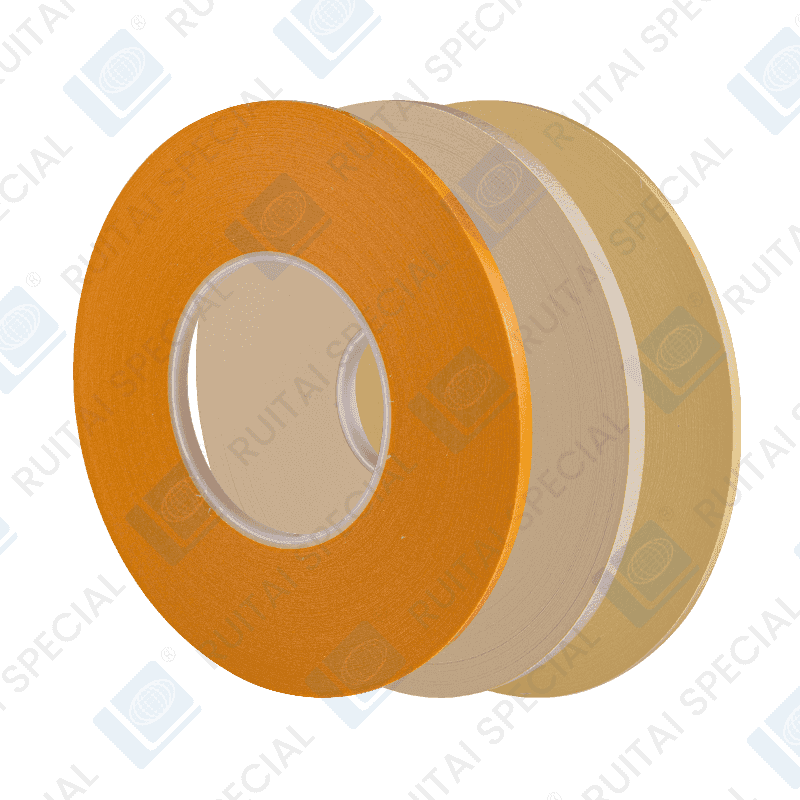
Temperature Grades and Where Each Applies
Choosing tape rated below the actual process temperature is the most common cause of masking failure — either adhesive residue baked onto the surface or the tape lifting mid-process.
| Temperature Grade | Approx. Rating | Typical Use |
|---|---|---|
| General purpose | Up to 140°F (60°C) | Interior painting, general surface protection |
| Mid-temperature | Up to 200°F (93°C) | Low-bake coatings, powder coat pre-masking |
| Automotive/high-heat | Up to 250°F (120°C) or higher | Automotive refinishing, bake-cycle paint booths |
Approximate temperature ratings for common masking paper tape grades.
Using automotive-grade tape for every job isn't necessarily the safer default — higher-temperature tape typically carries a more aggressive adhesive, which can be harder to remove cleanly from delicate or previously-painted surfaces than a general-purpose tape matched to the actual job.
Crepe Percentage and Conformability
Crepe paper tape is often described by a crepe ratio or elongation percentage, which indicates how much the paper can stretch before tearing. Higher-crepe tape (with greater elongation) conforms more easily around curves and contours — useful for masking wheel wells, trim edges, or irregular automotive body lines — but that same stretchiness can make it harder to lay a perfectly straight line by hand compared to lower-crepe or flat tape.
- High-crepe tape — best for curved trim lines, wheel arches, and detail masking where the tape needs to follow a contour
- Standard-crepe tape — the general-purpose choice for most masking tasks, balancing conformability with reasonable straight-line accuracy
- Flat paper tape — best for long, straight runs on flat panels or walls where crisp edges matter more than flexibility
Preventing Paint Bleed Under the Tape Edge
Paint bleed under the tape edge is the most common quality complaint, and it usually comes down to application technique rather than tape quality alone:
- Press the tape edge down firmly with a squeegee or fingernail immediately after application, since a loosely adhered edge is the primary path for paint to bleed underneath.
- Apply tape to a clean, dry, dust-free surface — dust particles trapped under the edge create micro-gaps that paint can seep through.
- For heavier coats or spray application, consider a second tape line just inside the first, or a wider tape width, to add a buffer zone against bleed-through on the critical edge.
On textured or slightly uneven surfaces, standard tape often struggles to seal fully regardless of technique — a foam-edge or high-tack specialty tape designed for textured substrates performs more reliably in that specific situation.
Removal Timing to Avoid Residue and Tearing
When tape comes off matters almost as much as the tape itself:
- Removing tape too soon, before paint has tacked enough to hold its edge, risks the wet paint edge pulling or smearing as the tape lifts
- Leaving tape on far past its rated exposure time, especially in direct sun or heat, increases the risk of adhesive residue transferring to the surface or the paper backing becoming brittle and tearing on removal
- Pulling tape back on itself at a low angle, rather than straight up, generally gives a cleaner release and a sharper paint line
For multi-day projects where tape needs to stay in place longer than its general-purpose rating supports, choosing a tape specifically rated for extended UV or outdoor exposure avoids the brittleness and residue problems that come from pushing a standard-grade tape past its intended removal window.